


Miniature wine bottles: the small format reinventing wine and spirit samples

What are miniature wine bottles and nip bottles? From collectible miniatures to the Vinotte®
In the world of wines and spirits, terms like nip bottle or miniature bottle refer to a small-scale vessel, often scaled down to mirror the design of the original bottle.
For decades, this small format mainly appealed to the retail market. Miniature whiskies, cognacs, rhums, or liqueurs were a common sight on flights, in discovery gift sets, and in private collections, some featuring thousands of items. Wine professionals were slower to adopt nip bottles, for a simple reason: filled in the open air, a small vial exposes the wine to a significantly higher proportion of oxygen than a standard 75 cl bottle. Within a few days, the aromas fade, the colour shifts, and the sample received by the buyer no longer resembles the original wine.
Definition and capacities of a miniature alcohol bottle
There is no single standard size for miniature wine bottles or spirit samples; it all depends on what you wish to present, to whom, and under what circumstances.
A cooper evaluating a vintage does not have the same requirements as a sommelier student during a sensory analysis session, nor a retail customer receiving a gift set. At Vinovae, we offer various formats in recyclable PET or glass.
| Format | Most common usage |
|---|---|
| 2 cl | Professional tasting serving |
| 4 cl | Format suitable for sharing between two people |
| 5 cl | Shared tasting or beginner format (also available in glass) |
| 10 cl | Mini-bottle for direct sales and the hospitality industry |
A 2 cl sample equals roughly two sips, the ideal pour for professional tasting, endorsed by industry experts.
Traditional nip bottle vs rebottled Vinotte®: the key differences
A standard nip bottle is typically filled by simple decanting from an opened bottle. The wine is directly exposed to air during this operation. While spirits with high alcohol content suffer minimal impact, oxidation begins immediately upon opening for single serve wine.
With the Vinotte®, any risk of oxidation is eliminated. The wine is rebottled using Vinovae’s patented process under an inert atmosphere, maintaining oxygen levels below 5 ppm. The Vinotte® is then sealed, preserving the organoleptic qualities of the wine for 3 to 12 months (depending on the format).
Why integrate miniature wine bottles into your B2B commercial strategy?
In traditional sampling, offering a taste to a buyer, importer, or journalist requires sending a full-sized bottle. It is heavy, fragile, expensive to ship internationally, and in most cases, only a single glass is actually tasted. Multiply this by fifty prospective clients, and the sampling costs quickly become a barrier to business development rather than a catalyst.
Compact formats provide a practical solution. Indeed, a single 75 cl bottle yields 18 single serve wine samples of 4 cl, or 36 samples of 2 cl. Using the same wine, you can reach 18 to 36 times more tasters. According to our data, sampling costs are reduced by a factor of 10 compared to shipping full bottles, while greenhouse gas emissions drop by up to 50 times compared to standard glass bottles.
In practice, this transforms operational approaches. A winery can test a new market without tying up extensive inventory, a trade body can dispatch the same tasting set to hundreds of influencers, or a wine merchant can offer a sample of a fine wine prior to purchase. We cater to both small bespoke runs and high-volume orders from our two production hubs in Europe and the United States.
To select your formats, boxes, and custom labels, explore our dedicated page on miniature wine bottles for professionals.
| What the Vinotte® delivers for you… | |
|---|---|
| Authenticity | A nose, appearance, and palate identical to the original full bottle |
| Cost savings | Tasting costs reduced tenfold |
| Customisation | Labels, boxes, and packaging tailored to your brand identity |
| Guidance | Expert advice, from initial concept through to final dispatch |
| CSR & Commitment | European manufacturing, recyclable Vinottes®, co-packing in partnership with supported employment facilities |
Our patented process: preserving 100% of wine aromas in miniature wine bottles
The smaller the liquid volume, the greater the impact of air contact, leading to rapid oxidation. It was from this technical challenge that our process was born, engineered by Grégoire Henry, co-founder of Vinovae.
“Rebottling takes place under an inert atmosphere, with oxygen levels strictly kept below 5 ppm. Temperature and pressure are monitored continuously throughout, while micro-filtration preserves the full integrity of the product. Every step is designed around one goal: ensuring anyone opening a Vinotte® tastes precisely what the winemaker bottled.” — Grégoire Henry, co-founder of Vinovae
Organoleptic qualities remain indistinguishable from the original bottle for 3 to 12 months depending on the format, providing ample time to ship samples globally, prepare training sessions, or build stock for a promotional campaign.
To explore each stage in detail, from material selection to quality control, read our dedicated page on the rebottling process for miniature wine bottles
Wine, whisky, rum: a miniature bottle solution for every spirit
Wine is not the only product catered for. We package wine in the Vinotte® and spirits in the Spinotte®, applying the same uncompromising standards of fidelity. Whisky, rum, cognac, gin: these spirits are often tasted side by side across multiple references, making small formats an ideal medium.
Each beverage brings its own specific requirements. What volume suits a heavily peated whisky designed for slow sipping? Is PET the best material for a premium aged rum featured in a luxury gift set? How can a distillery or estate convert an entire product line into consistent single serve wines or spirits? Material selection, capacity, and presentation vary depending on whether you are sampling a young rosé or an exclusive vintage prestige cuvée.
Distilleries have embraced this approach: miniature whisky and rum bottles have become essential tools for introducing product ranges, building customer loyalty, and creating tasting sets. The wine sector is following suit, where preservation standards are even more critical.
To select the right format for your product, consult our guide on miniature alcohol bottles by beverage type.
Trade shows, e-commerce, export, and corporate gifts: professional applications for miniature wine bottles
Small format bottles have evolved beyond novelty collectibles into powerful drivers for sales, education, and brand visibility. Here are the primary use cases for our clients.
Business development & exports: Producers and merchants can send wine or spirit samples to importers, retail buyers, or specialised press without shipping full cases. At trade fairs, compact Vinotte® boxes replace heavy crates of bottles, allowing visitors to take samples home for convenient tasting.
Training & remote tasting: Sommelier academies, WSET providers, and independent educators are digitalising wine education! Each student receives a dedicated learning kit containing precise pours that faithfully match the original wines, enabling remote tasting from home.
Regional & appellation promotion: Using the Vinotte® sample format, wine trade bodies and regional associations can launch innovative campaigns to introduce local terroirs to sommeliers, journalists, and buyers worldwide.
Retailers & e-commerce: Gift boxes, Advent calendars, and “try-before-you-buy” samples provide retailers and online stores with fresh ways to engage consumers and drive repeat purchases.
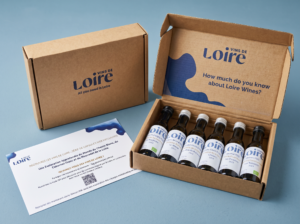
“I collaborated with Vinovae last March to produce 85 tasting sets intended for a webinar for German professionals. I was able to customize the labels and boxes with the colors of our graphic charter and integrate my own documentation—a tasting notebook—into each box. Logistics were greatly facilitated by the ability for each winemaker to send their bottles directly to Vinovae for rebottling. The process with Vinovae was very smooth and professional. The deadlines were perfectly met, allowing all participants to receive their box directly at home in Germany before the webinar. “ Emma Fontaine – InterLoire
Miniature wine bottles and sampling: frequently asked questions
What is the difference between a standard nip bottle and a Vinotte®?
A Vinotte® is a miniature sample bottle filled under an inert atmosphere using Vinovae’s proprietary patented technology. Conventional sample vials or standard nip bottle formats are typically filled in ambient air, exposing the wine to immediate oxidation. The Vinotte® preserves the original aroma, appearance, and flavor profile for 3 to 12 months depending on the size.
Which bottle size should I choose for professional wine tasting samples?
The 2 cl size is the industry standard for professional tasting pour.
The 4 cl format is ideal for two-person tastings.
The 5 cl bottle is preferred for extended tasting sessions and educational courses.
The 10 cl format is tailored for direct retail sales and hospitality settings.
How many samples can be produced from a single 75 cl bottle?
A standard 75 cl bottle yields 36 samples of 2 cl, 18 samples of 4 cl, 14 samples of 5 cl, or 7 samples of 10 cl. This efficiency explains the substantial cost advantage over sending full-sized bottles.
How long does wine keep in miniature wine bottles?
When rebottled using our patented process, wine retains its full organoleptic qualities for 3 to 12 months, depending on the Vinotte® format. In contrast, wine poured into a basic nip bottle exposed to air begins to oxidize as soon as the main bottle is unsealed.
Share your wines everywhere, preserved exactly as intended
Whether you are preparing an export campaign, an educational program, or a seasonal gift set, we support you from format selection to final dispatch. Experience it for yourself: request a sample set of Vinottes® and taste them alongside the original bottle!